Working paper
Leverage and Operating Risk in Asset Pricing: An Accounting Perspective
Abstract
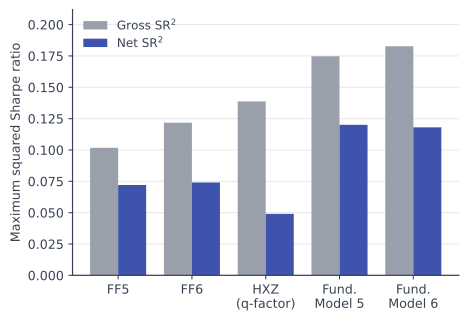
Separating operating from financial effects helps capture firm fundamentals, as these two types of risk tend to offset each other in the cross-section. We revisit the Fama-French six-factor model (FF6; 2018) by recomputing factors using operating characteristics while separately accounting for financial leverage. Our six-factor model subsumes the original FF6 model and outperforms the q-factor model (HXZ; 2015) in explaining a large set of documented anomalies. The improvement in capturing operating risk primarily stems from using return on net operating assets and growth in net operating assets as measures of profitability and investment, respectively. The enterprise book-to-market ratio becomes redundant once we consider the other operating characteristics. Additionally, after we control for operating effects, leverage is positively associated with returns, as predicted by theory, suggesting a renewed role for a leverage factor in asset pricing.
KeywordsFactor Models · Leverage · Valuation